Skip to content

Heuristic

  • GitHub
  • Email
  • Scholar
  • LinkedIn
  • Twitter
  • Instagram
  • Medium
  • Twitch

  • Cross-examining Neuroscience

    Moreso than most fields of science, neuroscience has very much a humane element in that what neuroscience says about the mind plays a central role in what makes us human. Our understanding of the brain spans strategies from naïve reductionism to cogito ergo sum. Are we computers or animals? Do our thoughts control us or do we control them? How does the reasoning of one person differ from another? But, in all the places these questions have shaken our self-understanding, the courtroom invites the greatest minds to bring justice from ethics, law, science, and everything else. How does neuroscience fare in the legal system?

    Before I continue, I must confess I know next to nothing about how much of the law works. Most of my understanding of the judicial system comes from watching “My Cousin Vinny” and playing Phoenix Wright: Ace Attorney. However, My interest in the issues scientists and physicians face comes from something more fundamental than what a lawyer thinks. It should be about what should be right and wrong. I hope this ethical examination of the biggest dilemmas in neuroscience could focus more on what people “should” do rather than what people “can” do. In other words, before we can come to a conclusion of whether or not something is illegal or not, we must take a look at the ethical understanding of neuroscience.

    “Uh… everything that guy just said is bullsh*t… Thank you.”

    The relationship between neuroscience and philosophy has always been tense. It would be far too easy to attribute much of who we are to the physical phenomena in the brain without paying attention to what ethicists and philosophers have written on morality.

    But our scientific understanding of the brain shouldn’t detract from any philosophical concept of free will. While science is able to explain anything about empirical, observable phenomena, the fundamental metaphysical framework of free will and the self remain underneath. Is it really true that our advances in biochemistry and neuroscience will change and possible our concepts of free will from philosophy? The issue that persists in courtrooms is that many contemporary philosophers argue that we only have physical freedom, as in, our free will only goes so far as to what our bodies are physically capable of doing. And, as neuroscientists continue to crack the code of the brain, some scientists have asked, “If everything is just a product of physical phenomena in the brain, how can we hold people responsible for anything?” We might need an understanding of neuroscience to enter the political and legal sphere for us to account for even the slightest of bias, cognitive or otherwise, that might impair our judgement. Neuroscientist David Eagleman suggests this deeper understanding of the mind could explain much of our behavior, and, through this, we can determine a person’s responsibility his or her actions (e.g., someone predisposed to a specific mental disorder might not be criminally guilty for committing a certain crime.)

    While using neuroscience to gain a better understanding of who we are is fine and dandy, things get complicated rather quickly. If a murderer had an abusive childhood, does that excuse him from responsibility of his actions? What about mentally ill criminals who, not only lack, but are physically unable to empathize? And, even if there are physical bodily responses that govern behavior, why should that stop at the uncontrollable forces within our neurons? What if the cause extended further, down to our own thoughts? Despite cries to end the idea of a “psychosomatic illness,” it’s certainly true that, when one imagines him or herself standing on the edge of a cliff, he or she experiences a physical response akin to the situation itself (e.g., sweating, rapid breathing, etc.) Does this mean that our own thoughts can control physical responses, and, in turn, control our behavior in this way, too? As the answers turn cloudy, it becomes clear that we can’t completely replace our notions of free will and responsibility with what neuroscience tells us about the physical connections in the brain. Before the brain can tell us what we’re culpable of in the courtroom, we should find a system of relating neuroscience with ethics.

    In order to do this, neuroscience research should become more ethically-focused and succumb less to the whims of other influences such as the government groups. Dr. Miguel Faria, Professor of Neurosurgery and Associate Editor in Chief of Surgical Neurology International, says neuroscientists should “adhere to a code of Medical Ethics dictated by their conscience and their professional calling — and not imposed by the state.” In addition, Faria warns of an authoritarian future in which the government has usurped scientific knowledge for its own purposes. He says, “Our modern society, not even in democratic self-governance, to say nothing of authoritarian systems, has not advanced in ethical or moral wisdom to deal with the problems emanating from the technical and social ‘progress’ of the age.” While a self-serving solution of discerning the defendant’s  responsibility based on his or her brain patterns might seem seductively plausible, a government-run nightmare looms around the corner. In the face of these threats, it’s up to scientists, the masters and diplomats of their own crafts, to make a statement to the world about what’s important.

    Maybe the fight between the forces of good and evil comes down to the matter of grit.

    No, not that kind of grit.

    No matter how hard we try to fight justice, it’s far more important for us to remain strong within ourselves about who we are. While the debates rage on, the grit that drives us to keep trying might someday save the neuro- disciplines from brain-bashing and help lawyers get their paperwork together. Until then, the jury’s out. 

    November 23, 2015
    Philosophy, Science

  • Protecting the Privacy of Mental Health Data

    37887-stigma
    The paranoia of everyday life

    Read this article in the Indiana Daily Student here….

    When speaking about the rights of an individual to his/her personal information, it’s easy to overlook the “personal” nature of mental health data. And, within the rhetoric of mental health, we spend a lot of time expressing the behavior, feelings and thoughts of those who suffer from mental illness, but we forget about the a deeper issue: who should know about it?


    How much can more data actually help us? With so much information about ourselves, it’s easy to be misguided. Some, like Jesse Singal of NYMag’s “Science of Us,” have decried the calls of certain mental health issues at universities  tremendously serious, yet suffering from confirmation bias or similar statistical fallacies. [6] If anything, we might just well be overwhelmed by how much we know about ourselves scientifically that we forget the humanistic aspect of ourselves. Basic science research in psychiatry hasn’t reached the goals it has claimed to make over the past few decades. Will turning to the social sphere, like Insel suggests, do any better?

    As science and medicine call for greater access to information for the purpose of research and clinical treatment, privacy becomes an issue. When we collect information from an individual, whether it’s a medical record from a hospital or a meeting with a school therapist, we have to protect his or her rights. How can we make sure data doesn’t fall into the wrong hands? What if a scientist’s data is used without permission or for unintended purposes?

    “But we would want you and your family members…to take part because we want to have that information…And that’s obviously also going to be very sensitive but very important because it’s such a problem in this country.” – Francis Collins[7]

    References:
    [1] http://www.nytimes.com/2015/09/16/health/tom-insel-national-institute-of-mental-health-resign.html
    [2] https://www.washingtonpost.com/news/answer-sheet/wp/2015/11/12/the-astonishing-amount-of-data-being-collected-about-your-children/
    [3] http://www.nih.gov/news-events/news-releases/new-prize-competition-seeks-innovative-ideas-advance-open-science
    [4] http://www.hhs.gov/ocr/privacy/hipaa/understanding/special/mhguidance.html
    [5] http://www.pbs.org/newshour/bb/push-use-human-genome-make-medicine-precise/
    [6] http://nymag.com/scienceofus/2015/11/myth-of-the-fragile-college-student.html#
    [7] http://thedianerehmshow.org/shows/2015-09-28/nih-head-francis-collins-on-new-efforts-to-use-medical-records-of-volunteers-to-treat-diseases
    [8] http://www.thestar.com.my/story/?file=%2f2008%2f10%2f15%2fcentral%2f2246634&sec=central

    November 21, 2015
    Medicine, Philosophy

  • Science’s Story: The Empathy of Physics

    leibniz
    What story did Leibniz share?
    Read this article in the Indiana Daily Student here….
    November 16, 2015
    Science

  • Color of the Song: A Look at Synesthesia

    Read this article in the Indiana Daily Student here….

    On a broader scope, if we associate semantic meanings with what we perceive, then maybe we can understand how our brain reacts to ideas themselves, and, in turn, understand the biological basis of perception. In addition, we perceive meaning and ideas far too complex to be explained by a neuroscientific understanding of the brain. For example, on when we perceive the beauty of art, “our senses do not easily grasp the complex aspects of the richly textured meaning of art,” says Anjan Chatterjee of The Scientist. Regardless, we may be coming close to understanding of certain ideas, as, according to scientists Tomohiro Ishizu and Semir Zeki from University College London, [2] when we see something beautiful, various parts of the brain, including the ventral striatum, are triggered. This could explain the biological basis of how we perceive beauty, and, in similar ways, we could find a biological basis for how we perceive the world. But we shouldn’t carried away with our understanding of the mind. There’s still a great deal of disagreement between neuroscientists, philosophers and everyone in between.

    If anything, synesthesia is a way our bodies speak to us. And, in that sense, we express it in our language and literature. We may describe a dull grey stone metaphorically as a melancholic, somber appearance with a droning bland tone. A sharp pointed object may invoke fright or high-pitched shrieks of stringed instruments. Through other forms of media, a guitar might gently weep or a streetcar may desire. Synesthesia could be evidence that our literary metaphors are grounded in our psychology.

    References:
    [1] http://nautil.us/issue/26/color/what-color-is-this-song
    [2] http://journals.plos.org/plosone/article?id=10.1371/journal.pone.0021852
    [3] http://www.the-scientist.com/?articles.view/articleNo/39802/title/Neuroaesthetics/
    [4] http://ed.ted.com/lessons/ideasthesia-how-do-ideas-feel-danko-nikolic
    [5] http://www.stresstips.com/what-is-ideasthesia/

    November 13, 2015
    Science

  • The War in Science in the War

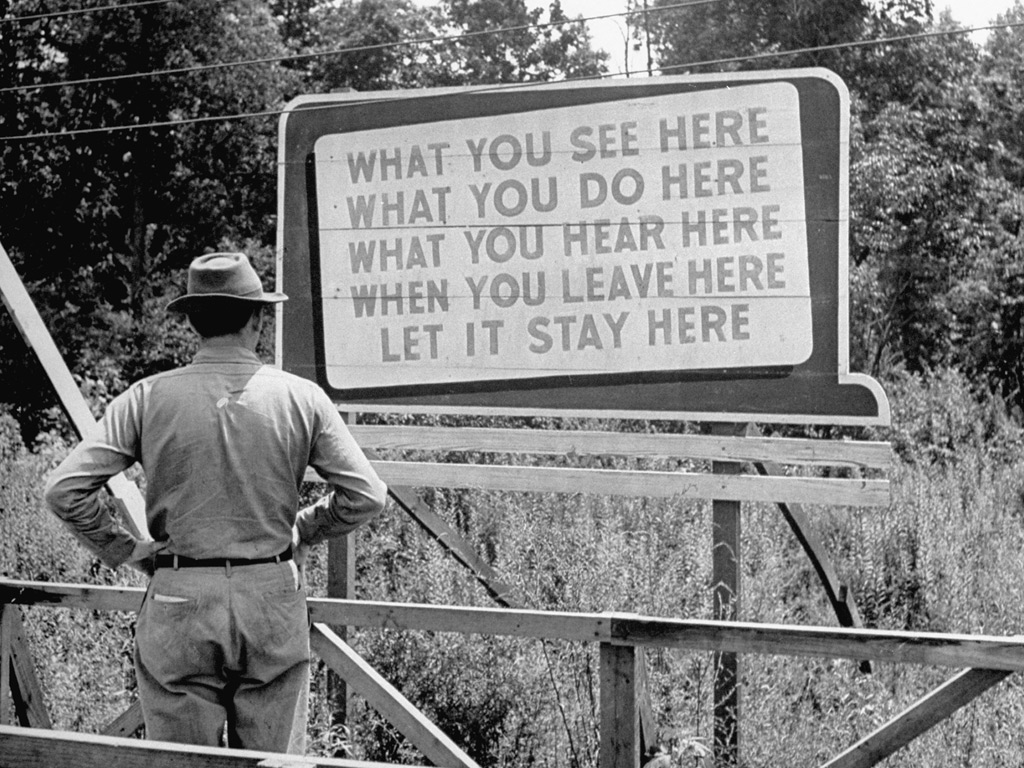
    A billboard at Oak Ridge Facility in Tennessee warns people to keep silent about anything they see or hear there. Oak Ridge was a town built in 1942 to house workers and the laboratory that developed the Manhattan Project – the secret second world war program that built the atomic bomb. 

    Whether we like it or not, science has been a key player in our political affairs. The acronym STEM (Science Technology, Engineering, and Mathematics) arose partly out of national security concerns such as World War II, the War on Cancer, and the Soviet Union’s launch of Sputnik. But how has science really played out through the wars?

    Read this article in the Indiana Daily Student here…

    When we remember Eisenhower’s 1961 use of the phrase “military-industrial complex,” some historians argue the phrase was originally meant to be “military-industrial-scientific complex.” According to Ben Schott of the New York Times[2], this claim has been debunked, and there was “scientific” term in the phrase. But, though we never meant to describe the militarization of our nation with the word “scientific,” the role science has played in our militarized economy has lingered.

    Over the past century, the US has witnessed ups and downs in our hopes as a nation. These sentiments have permeated through the scientific world. In Sarah Bridger’s book “Scientists at War,” she says scientists successfully flourished in the years after World War II. But, during the Vietnam War, several individuals of the science community became suspicious. [1]

    The ethics of science in politics has been debated throughout the 20th century. Jacob Darwin Hamblin, Professor of History at Oregon State University, says scientists assisted in atomic energy regulation as well as Soviet Union diplomacy. During the 50s and early 60s, military research research blossomed as the US competed against the Soviet Union.

    References
    [1] http://www.americanscientist.org/bookshelf/pub/an-ethical-evolution
    [2] http://schott.blogs.nytimes.com/2011/01/25/guest-post-james-ledbetter-on-50-years-of-the-military-industrial-complex/?_r=0

    November 12, 2015
    Science

  • Making Sense of Statistics

    “Figures often beguile me,” he wrote, “particularly when I have the arranging of them myself; in which case the remark attributed to Disraeli would often apply with justice and force: ‘There are three kinds of lies: lies, damned lies, and statistics.’” – Mark Twain

    Very few of us truly understand numbers. Some simply aren’t good at math, others haven’t had the best learning methods, and there are people without the appropriate information. Regardless, we have a moral imperative to learn how to make sense of quantitative information when it affects our lives in the way it does. News channels, politicians, and professionals from all fields clutter speeches and proposals with percentages, figures, theories, and anything else built of numbers. As a result, mathematics has gained ulterior political motives through agendas, poor analysis skills, and a lack of humanism in our interpretation of statistics. More than ever, these are the times when we fear what “studies say” or “science reports” about the things we do, the way we eat, the clothes we wear, the prevalence of sexual assault on campus, or the presence of guns in our garages.

    Numbers are seductive. It’s easy for us to fall victim to the allure of believing what isn’t necessarily true. As Russian mathematician Edward Frenkel wrote in his Euler-winning book, “Love and Math: The Heart of Hidden Reality”:

    If you ask a drunkard what number is larger, 2/3 or 3/5, he won’t be able to tell you. But if you rephrase the question: what is better, 2 bottles of vodka for 3 people or 3 bottles of vodka for 5 people, he will tell you right away: 2 bottles for 3 people, of course.

    What makes the rephrased question different from the former? The statistics are presented differently. In the second question, we have a more “tangible,” usable way of understanding how the proportions of vodka would be arise from the distribution among people. Though Frenkel tries to explain his sophisticated, advanced mathematical theories to a general audience, we don’t have to be Einsteins or engineers to understand the basic skills necessary to thrive in today’s society.

    Let me ask you the question: How well do you understand statistics? Try answering this question to find out.

    Assume you conduct breast cancer screening using mammography in a certain region. You know the following information about the women in this region: The probability that a woman has breast cancer is 1% (prevalence). If a woman has breast cancer, the probability that she tests positive is 90% (sensitivity). If a woman does not have breast cancer, the probability that she nevertheless tests positive is 9% (false-positive rate).

    A woman tests positive. She wants to know from you whether that means that she has breast cancer for sure, or what the chances are. What is the best answer?
    A. The probability that she has breast cancer is about 81%.
    B. Out of 10 women with a positive mammogram, about 9 have breast cancer.
    C. Out of 10 women with a positive mammogram, about 1 has breast cancer.
    D. The probability that she has breast cancer is about 1%.

    When German psychologist Gerd Gigerezner posed the question to about 1000 gynecologists, about 21% chose the correct answer, C. While that is a little worse than random guessing, I must admit that, on my first attempt, I failed to answer this question correctly, as well. Through his research, Gigerezner has crafted a theory of understanding statistics that would help us in situations like this. Similar to Frenkel’s example of the fractions of vodka, psychologists like Daniel Kahneman and Gerd Gigerezner have shown that asking statistics questions in different ways can influence the ways we understand them. For example, when the information preceding the question is framed differently (as shown below), 87% of gynecologists answered correctly.

    Assume you conduct breast cancer screening using mammography in a certain region. You know the following information about the women in this region:  
    Ten out of every 1,000 women have breast cancer
    Of these 10 women with breast cancer, 9 test positive
    Of the 990 women without cancer, about 89 nevertheless test positive

    In both examples (of breast cancer screening and of bottles of vodka), when we change from “conditional probabilities” to “natural frequencies,” we suddenly understand statistics much better. Like Gigerezner, I believe the appropriate way to interpret statistics is something we can teach, and, with the effect it has on our health and society, we have a moral imperative to do so.

    This isn’t a simple case of deliberately communicating false information or lying about the statistics we use. While there may be agendas and conflicts-of-interests between professionals (including scientists), we simply don’t understand how to interpret statistics. And, in the field of medicine, this can have disastrous results. We make poor decisions about how long a patient may live, how prevalence of cancer among smokers, and understanding the harms and benefits of screening for breast cancer.

    Numbers don’t lie, but they’re difficult to understand.

    November 11, 2015
    Science

  • A Theory of Everything, for Everyone

    Read this article in the Indiana Daily Student here….

    Hilbert’s tomb

    Since a theory of everything would unite all the forces of matter, it would be elegant in how much information could be explained so simply. The math and physics behind theory would all have a function with everything else, and there would be nothing below it. As MIT Physics Professor Frank Wilczek put it, “You can recognize truth by its beauty and simplicity.” [3] But, during the 19th century, while physiologist Emil du-Bois Raymond proclaimed “ignoramus et ignorabimus” (or “we do not know and we will not know”), mathematician David Hilbert would write “For the mathematician there is no Ignorabimus, and, in my opinion, not at all for natural science either. … The true reason why [no one] has succeeded in finding an unsolvable problem is, in my opinion, that there is no unsolvable problem. In contrast to the foolish Ignorabimus, our credo avers: We must know, We shall know.’”

    Beyond what physics can tell us about how matter and forces work, there are issues with the way mathematical statements can actually explain the world. Is mathematics the language through which we describe nature or is it something that nature itself is made of? Is a theory of everything the end of knowledge the same way all biological organisms evolved from a single one? And what if there is no theory of everything? As 20th century American physicist Richard Feynman speculated, it is possible there is no theory that applies everywhere all the time.[1] Everything we observe will have something below it, and we’ll never get to any most fundamental theory.

    Doing Gödel’s work, son

    We might be inclined to search for an answer in logic, a field that we think would prove the answers to all forms of reasoning, and, therefore, all knowledge. The most striking example of how we can prove/disprove these sorts of answers lie in Kurt Gödel’s theorems that explain how there exist mathematical statements that can’t be proven. And, one might think that, similarly, there are is physics information that can’t be proven, either. The trouble with this is that, while Gödel’s Incompleteness theorems only say for some fixed, recursively defined, axiom system there are statements you can’t prove or disprove, that shouldn’t matter for physics because you can just add new axioms when you want. Physics doesn’t require a fixed-axiom system.

    Save work on the Standard Model (on the fundamental forces and their interactions), theoretical physics hasn’t had much success over the past few decades. There are things like string theory, loop quantum gravity, and similar theories, but, while they are ideas that could be true, we don’t know.

    The are epistemic problems with a theory of everything, as well. Why is it true that we can understand anything? Does finding out how the laws of nature work explain why they are the way they are? And, if we don’t know everything, how can we know anything?

    References:
    [1] http://nautil.us/issue/29/scaling/the-trouble-with-theories-of-everything
    [2] http://www.pbs.org/wgbh/nova/physics/theory-of-everything.html
    [3] http://ppp.unipv.it/collana/pages/libri/saggi/nuova%20voltiana3_pdf/cap4/4.pdf

    November 8, 2015
    Science

  • Mental Illness as a Language

    menalthalbrain.png

    Read this article in the Indiana Daily Student here….

    Mental health is an increasingly important issue. The World Health Organization estimates mental disorders will have become the world’s largest cause of death and disability by 2020. [3] Alongside this, we’ve put forth tremendous effort to understand our mental health from a scientific point-of-view. Our post-Enlightenment positivist view of scientific happiness has exponentially grown in accuracy. Though we’ve been doing this since the eighteenth century, in recent years, we’ve become more and more observant and critical of how our minds truly function in the scary world. All of our actions, behaviors, and moods can be measured down to a very fundamental level. But these efforts ignore the socio-political and cultural tendencies that have driven mental health over the centuries. In spite of this, it’s no wonder mental illness is on the rise.

    Still, some criticize the field of psychiatry for being scientifically backwards. But far more insidious is the cultural deafness. Many of us have forgotten the role culture plays in mental health because we have tried to only use science to explain mental health.[1] However, our knowledge of the brain is is still very far from explaining mental disorders. We should remember the symptoms of mental illnesses are, not only scientific issues, but also a language through which we express ourselves. And we need to understand our culture and history to figure out what our distressed unconscious tries to tell us.[1] Maybe mental illness is not a “harmful defect we shun” and more a way we understand who we are. Seen this way, the mental issues we face are less of “biological flaws” and more of ways we express ourselves in society.

    Speaking of the 21st century, our anxieties and insecurities are probably more philosophically and existentially grounded than we like to think. Many of us struggle with the postmodern irony and individualism that simultaneously shuns tradition while embracing conformity. Some of us call ourselves “introverts” as a form of self-identification to internalize some of our behaviors as “natural” or “acceptable.” We look at all the other amazing introverts and find some sense of belonging. But labeling ourselves just covers up who we really are. Others among us chase ideas and culture in hopes that we can find something unique about ourselves, that separates us from other people, but we’re only sharing the same social assumptions about what defines us.

    The same way culture fashions us to understand aesthetics, value, ethics, and other humanistic qualities, our struggles with the emotions of mental illness could be the way our bodies understand the world. Einstein himself found solace, not only in science and art, but in the philosophical work of Schopenhauer, as he wrote on Planck’s 60th birthday:[4]

    To begin with, I believe with Schopenhauer that one of the strongest motives that leads men to art and science is escape from everyday life with its painful crudity and hopeless dreariness, from the fetters of one’s own ever shifting desires. A finely tempered nature longs to escape from personal life into the world of objective perception and thought; this desire may be compared with the townsman’s irresistible longing to escape from his noisy, cramped surroundings into the silence of high mountains, where the eye ranges freely through the still, pure air and fondly traces out the restful contours apparently built for eternity.

    Maybe our searches for “objectivity” of understanding mental illness are caused by these similar desires that motivate scientist. In this sense, our mental health is the way we search for meaning and satisfaction in the world.

    All the world’s a stage, And all the mentally ill merely players.

    References
    [1] http://www.psmag.com/books-and-culture/real-problem-with-dsm-study-mental-illness-58843
    [2] http://mh.bmj.com/content/28/2/92.full
    [3] https://newhumanist.org.uk/articles/4934/the-cost-of-happiness
    [4] http://www.neurohackers.com/index.php/fr/menu-top-neurotheque/68-cat-nh-spirituality/99-principles-of-research-by-albert-einstein

    October 26, 2015
    Medicine, Philosophy

  • How Much Do We Know About the Brain?

    Read this article in the Indiana Daily Student here….

    Neuroscience is sexy – don’t believe the hype.

    Neuroscience, the scientific study of the nervous system, has allowed us to understand how our brains work.

    In addition, with our ever-increasing knowledge of social and behavioral sciences, we have gained a lot of insight into human behavior. And neuroscience gives us empirical evidence (verified through scientific experiments) for how the brain influences that behavior. But the brain isn’t simple, and neither is our behavior.

    In 1993, scientists used brain science to claim listening to Mozart increased mental activity, and the public believed listening to classical music would turn us into Einsteins. Sales for classical music skyrocketed, but the conclusion was false, and the public was mislead us by what we wanted to believe. [1]

    What about psychiatry and psychology? Surely those fields must offer bridges between the physical sciences and how we understand human behavior, right? Joe Herbert, Professor of Neuroscience, says we’ve already moved Alzheimer’s from psychiatry to neurology. Maybe we can do so with the rest of mental illness? We have “partial” ways of diagnosing depression that look at some sets of symptoms to give “somewhat” effective treatments, but, since the situation is much more confusing than a simple “depression gene”, we do have to revamp our psychiatric models and theories to keep up with both science and culture.

    Speaking of culture, there are issues with a neuroscientific approach to what makes us human.  Most scholars of music, for example, oppose “universalist” approaches to using music as something that has universal values among peoples. Similarities between elements of music across time and space may indicate something of a “grand unified theory” of music. Some might say this search for “universals” stems from a neurobiological foundation that all human beings share, and, therefore, would be present in all of our cultures. Seen this way, all people in the world share, not only “brains”, but “minds. Perhaps this could help us understand the relationship between the human sciences and neuroscience?

    While we may be moving closer, the limits prevent neuroscience from penetrating music culture. Aesthetics, language, philosophy, and similar fields follow suit.

    But let’s not completely throw neuroscience away. The field of brain science will always give us beautiful findings of how things work, and, with the reductionist restraints that we must remember, the field is even more amazingly exciting than we could imagine. We’re still who we are, but we should remember how to put our findings and knowledge in context. Neuroscience should not hold onto outdated cognitive theories nor remain devoid of culture and philosophy. While neuroscientists may proclaim “cogito ergo something or other,” the misleading tendencies among neuroscientists are, indeed, mistakes scientists should be responsible for, and, non-scientists, as well, can understand neuroscience better through effort.

    We like to think, “If it’s the brain, it must be science, and if it’s science, it must be true.”[3] Novelist Marilynne Robinson calls this scientific reductionism a form of “Prometheanism.” The “objectivity” of neuroscience is both dangerous and misleading. Even the amazing polyglot Raymond Tallis objects to “neurotrash” with regards to social policy. Let’s remember that we’re all more complicated than a bunch of neurons and genes.

    As a student who has been involved in neuroscience research, I understand the science of the brain is exciting, rewarding and important. But, whether we’re scientists or not, we should take findings of neuroscience with a grain of salt.

    References:
    [1] http://www.ncbi.nlm.nih.gov/pubmed/8413624?dopt=Abstract
    [2] http://www.bio.davidson.edu/courses/genomics/2002/pierce/gaygene.htm
    [3] http://bigthink.com/devils-advocate/is-neuroscience-overrated
    [4] http://www.discovery.com/tv-shows/other-shows/videos/other-shows-science-of-sex-appeal-videos/
    [5] http://www.psychologicalscience.org/index.php/publications/observer/2013/april-13/why-wait-the-science-behind-procrastination.html
    [6] http://www.scienceofpeople.com/2015/03/the-science-of-lying/
    [7] http://www.scientificamerican.com/article/why-the-human-brain-project-went-wrong-and-how-to-fix-it/
    [8] http://www.theguardian.com/science/2014/jul/07/human-brain-project-researchers-threaten-boycott
    [9] http://www.nationalpost.com/m/wp/blog.html?b=news.nationalpost.com/2014/07/08/a-billion-dollar-european-effort-to-model-the-human-brain-in-a-supercomputer-is-in-danger-of-collapsing
    [10] http://www.cwfa.org/images/content/bornorbred.pdf

    October 23, 2015
    Science

  • A Modern Look at Science’s Anglophonia

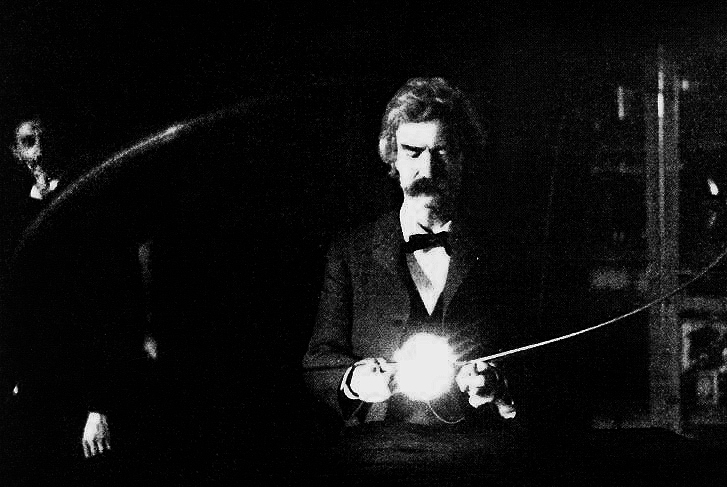
    Don’t cross the streams: Mark Twain messing around in Nikola Tesla’s laboratory in 1894. Twain’s fascination with technology lead him to engage in many amazing conversations with the physicist-engineer. The literature and writing covering Tesla’s work (from the oscillator, the lightbulb, and the alternating current), much like the rest of science, wouldn’t be the same without an English-driven nature of science.

    During the summer after my freshman year, I was given the wonderful opportunity to study plant biology at the Boyce Thompson Institute for Plant Research at Cornell University. To my surprise, I ended up working in a lab with entirely Chinese scientists. Most of them casually communicated in their native language with each other. Apart from awkward lab lunches and some difficulties communicating about the research, it wasn’t a big issue for me. (Of course, some of my mentor’s programming notes were, to my disadvantage, written in Chinese). But I realized how much of a struggle it is for non-English speakers to become scientists. Though my family is from India, I had the luxury of growing up multilingually (in a household that spoke English, Hindi, and Arabic), but for the aspiring researcher in Costa Rica, Saudi Arabia, or Malaysia, the English-driven, or Anglophone, world of science is a struggle.

    Granted, the history of science has had a love-hate relationship with multilingualism. In 1869, Dmitri Mendeleev published the periodic table in Russian, but, because it wasn’t in German, it was difficult for the knowledge of this discovery to reach almost other places in Europe (such as Germany and France).

    Science used to be the language of polyglots; books, theories, data and all other forms of research were communicated in French, Latin, German, and other languages. But, in the advent of the World Wars, lingual international fervor took a hit, says Michael D. Gordin, historian of modern science at Princeton. Some advocated “unifying” languages like Esperanto, but, through the political turns of the 20th-century (namely the World Wars and Cold War), English emerged as the dominator of science. And the Anglophone majority persists today, whether or not you’re at a research conference in Berlin or a meeting in Tokyo.

    Though it takes a lot of effort to maintain English on such a large scale of science today, it’s efficient among English-speakers in Western and Eastern nations alike. If you know English, you can communicate with pretty much any scientist. We can disseminate information more quickly and with greater accuracy if everyone shares a common language. But there are drawbacks; for one thing, the monoglot nature of science creates a language barrier for anyone to enter the field. It’s one thing for someone to struggle with mathematics because he or she doesn’t understand differential equations, but what if someone couldn’t become a physicist just because he or she didn’t speak English?

    A sugar cane plantation in the West Indies in the early 19th century. The agriculture, botany, geology, economic geography, and other scientific endeavors were central to British Imperialism, according to John MacKenzie, Professor of Imperial History at the University of Lancaster.

    The Anglophonia of science might be the bullet that non-English speakers have to bite. If you don’t publish in English, it’s very unlikely that your work will be noticed. We’ve evaluated the efficiency of multilingualism in science at the individual level. We’ve come to accept that the individual must do whatever it takes for him or her to become a scientist, rather than making reforms and changes to the entirety of science. Unfortunately, the language of science has been decided by the grand scheme of politics throughout history. From this, we end up with a system in which, if English is the norm, then individual scientists have to learn English or perish.

    Some might make the argument that, by approaching the scientific topics and issues in different languages, we expose ourselves to different cognitive processes that help us understand science better. But there isn’t so much support for the idea that different languages influence cognitive processes (ie., Whorf hypothesis, linguistic relativity, etc.) so much as there is evidence that English barriers block others from entering science. Studying organic chemistry in Spanish might not “exercise your brain” much more than doing the same in English. Galileo thought that the nature is written in the language of mathematics, but it seems ridiculous to argue that nature is written in any human language or combination thereof. Similarly, it’s hard to imagine that science could be guided by whether or not we choose to speak Swahili or German.

    Besides, it’s not so clear whether or not science could afford to take the time and resources to embrace different languages in the current state of science. Though the current burden lies on individual non-English speakers, it would be an even greater burden for journals, labs, and entire organizations to reproduce, translate, and think through results in multiple languages.

    While my Mathematics professor from Japan struggles to pronounce certain English letters, we can pretty much understand what he says. Especially at the globally-minded universalist nature of the university,  we can ease the barriers to entry for most people. 

    October 18, 2015
    Science

Previous Page Next Page


Loading Comments...
 

    • Subscribe Subscribed
      • Heuristic
      • Already have a WordPress.com account? Log in now.
      • Heuristic
      • Subscribe Subscribed
      • Sign up
      • Log in
      • Report this content
      • View site in Reader
      • Manage subscriptions
      • Collapse this bar