 |
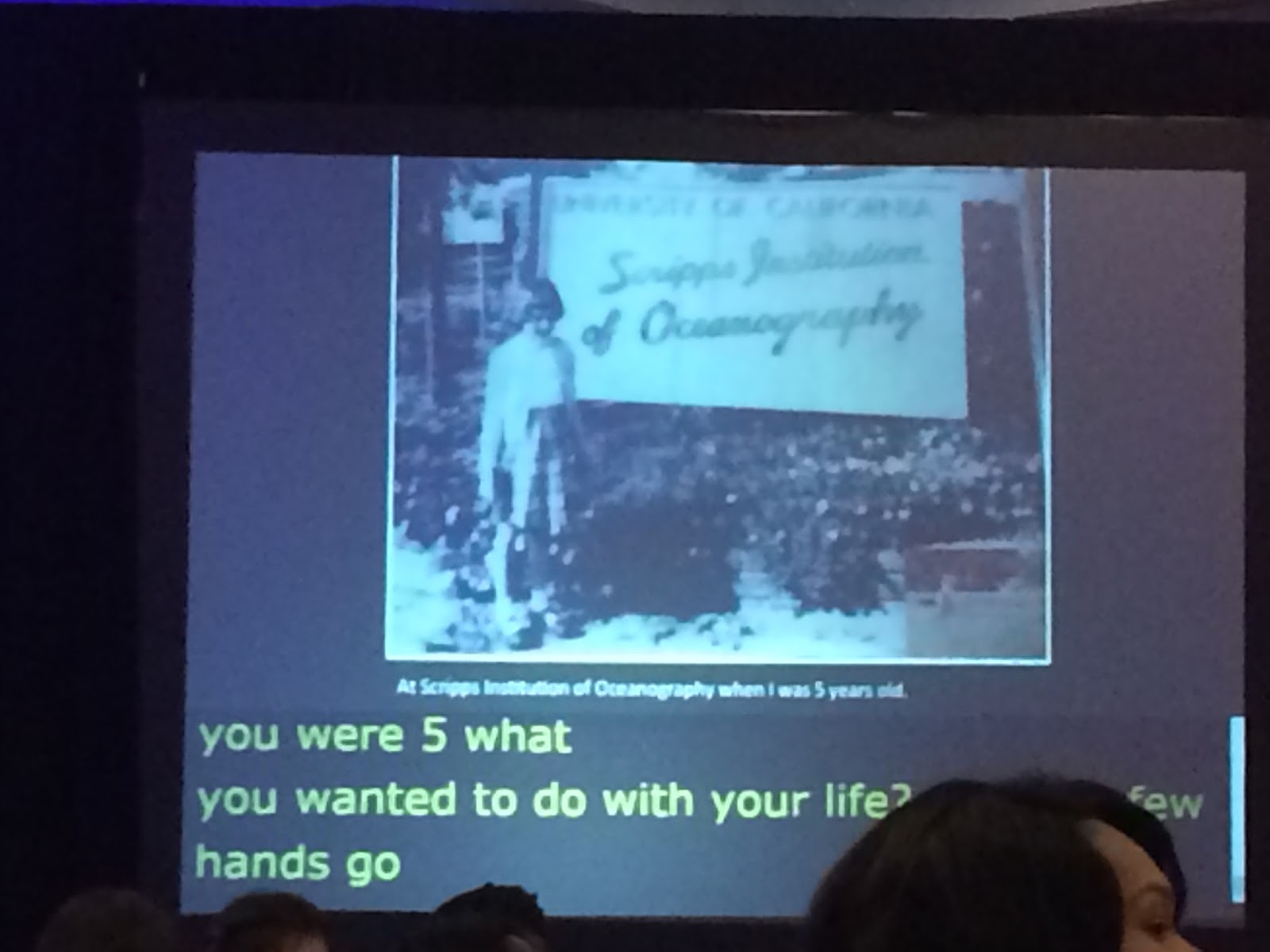
| Marcia McNutt, Editor-in-Chief of Science, talks about her childhood at the Emerging Researchers National Conference in Washington D.C. |
Tag: Science
-
When you should trust a scientist
-
Building and branding a student
An interview with Xyla Foxlin.
source In this interview with Xyla Foxlin, sophomore at Case Western University, I want to explore the budding engineer’s philosophy and perspective of education. Throughout her life, Xyla has made innovative achievements both academically and personally. She’s cultivated a purpose for herself while confronting questions and challenges, including the value of a college education and the intersection of engineering and art.
Hussain: What made you interested in engineering?
XF: I love building things, designing things, and working with my hands. I’ve always been interested in art, and I still view engineering as just another form of art with a technical spin. But in a nutshell, I think robots are the coolest thing ever and my focus is in robotics.
Hussain: Tell me about Parihug. What is it and what’s so special about it?
XF: Parihug is a pairable teddy bear that allows you to hug someone from anywhere in the world. A breakthrough in telecommunication, these teddy bears are accessible haptic toys; a plush toy that is designed to escape the uncanny valley and help children and adults alike build relationships with loved ones far away. When one bear is hugged, a suite of soft, fabric-based, analog sensors alerts the bear, sending a signal to its mate over the internet, and sending hugs across thousands of miles.
Hussain: You mentioned you’re almost “in college just for a sheet of paper.” In some sense, it might be true that you are in college “just for a sheet of paper.” What makes you think this way?XF: I think everyone learns very differently, and academia only caters to very specific learning styles. It frustrates me that we are only supposed to learn and think in certain ways and this mentality pushes people out of STEM and even college in general very frequently. In today’s society though, a degree is expected, so I’m just here to get that. I do my learning out of the classroom.

Hussain: Some have criticized the idea that college should be a place to prepare students for future careers and be economically productive. Do you think this purpose (to use college in order to be economically productive) has any negative effects on students, society, or anything else? If so, have you ever experienced these negative effects?XF: I think certain colleges do this very well, and some don’t. Colleges have a focus – vocational schools or polytechnic universities do just that – prepare students for future careers. Research and theory based universities focus on preparing students for research and academia. I personally prefer the polytechnic attitude, but that’s simply because it is what works better for me. To each their own, I think the important thing is that students can have options.
Hussain: You say you see engineering and art as the same thing. Could you tell us more about what you mean by this?
XF: Art and engineering have the same founding principles: they’re a reaction to observations of the world. Many concepts found in art rely on the same principles of physics that engineers have built their foundations on. Both require creativity and I do believe that art training should be a requirement for engineers.
Hussain: Tell us a book you think everyone should read.XF: “Walt Disney Imagineering: A Behind the Dreams Look At Making the Magic Real”
-
Gene drive – take the wheel against malaria
 Scientists are coming closer and closer to the dreams of genetic engineering just aboutanything for any purpose. Now we can drive those dreams home by engineering mosquitos inorder to eliminate malaria, one of the biggest health and economic threats faced bydeveloping nations.
The new tool – known as the gene drive – lets us genetically modify entire species.
Recently, scientists have used it to modify mosquitos in order to eliminate the spread ofdiseases like malaria and dengue fever.Though a gene drive would only work with organisms that reproduce quickly (not withhumans), we can harness its power to combat diseases spread by insects, control invasivespecies, or even eliminate herbicide-resistance.And it might be one of the most powerful technologies we’ve ever had.Biologists Ethan Bier and Valentino Gantz at the University of California San Diego andAnthony James at the University of California Irvine have used the tool to engineer mosquitosthat can’t transmit malaria to humans. If we genetically modified a group of mosquitos thisway and added them to the wild, they would spread their anti-malaria gene to others. Overtime, we can prevent mosquitos from spreading the disease to humans and slowly eliminatemalaria completely. The scientists showed the gene drive method works efficiently in male and female mosquitosfor a great deal of genetic possibilities at specific targets in the genome.The technology works by using endonucleases, biological catalysts for speeding up chemicalreactions of DNA, to cut specific genes in our DNA of our genome. Then, the drive gene wewant gets copied into the genome, and, when the DNA repairs itself, it copies the drive gene.By controlling which genes are cut and copied, scientists can change our genetic makeup.With gene drive, we insert genes on both chromosomes for two individuals within apopulation, then, when those two individuals sexually reproduce, the gene will be on bothchromosomes in each offspring. This way, we can add the modified organisms of the genedrive to populations so that, over time, the genes will be found in all individuals in thepopulation.The scientists’ success came from the use of the new genome-editing system CRISPR-Cas9(pronounced “crisper cas nine”). CRISPR, short for “clustered regularly interspaced shortpalindromic repeats,” uses the parts of DNA that have short repetitions sequences that arespaced our between genes, as the name would suggest. The Cas9 protein is anendonuclease used by bacteria to edit DNA, and, when the researchers sent the Cas9 intocells, they were able to modify an organism’s DNA at any location.In recent years, CRISPR-Cas9 has shown promising results by using sections of RNA, amodified form of DNA, to target locations in DNA sequences to be added, changed orremoved. It has already been used to modify mosquitos, fruit flies, yeast, and evenunfertilized human embryos.Though we can’t use gene drives on humans, the power and success of CRISPR-Cas9 hascaused scientists to raise concerns about the safety of the gene drive technology. If we haveso much control over biology, then who should be able to control the genetics of otherorganisms? If we can permanently eradicate certain disease and protect populations, howshould we maintain an ecologically healthy environment?There are also difficulties in implementing gene drives. Unlike, for example, geneticallymodifying food, it’s not easy to keep engineered organisms from spreading outside of adesignated field or area. The gene drive may have unintended impacts as it is carried out onthe population or its surroundings.Scientists need to figure out the best ways to proceed as efficiently and carefully as possible.Since mosquitos are detrimental to our health and not absolutely necessary, modifyingmosquitos isn’t so controversial.But given the sheer potential that lies in our genome and our power to change almostanything about our biological structure, we need to ask ourselves the important questions thatwill shape our future. The potential to help or hurt lie in the hands of these new technologies,and the way we use them will carry powerful impacts on the future. Scientists, policymakers,ethicists, and other professionals will have to work together to decide how transparentpractices should be, how much we should experiment and, ultimately, what we should do.How much power is it right to have over Mother Nature?A gene drive isn’t just an Uber ride, but a full-fledged road trip.
Gantz, V., Jasinskiene, N., Tatarenkova, O., Fazekas, A., Macias, V., Bier, E., & James, A. (2015). Highly efficient Cas9-mediated gene drive for population modification of the malaria vector mosquito Proceedings of the National Academy of Sciences, 112 (49) DOI: 10.1073/pnas.1521077112
-
Chaos under control (from butterflies to Hitler)

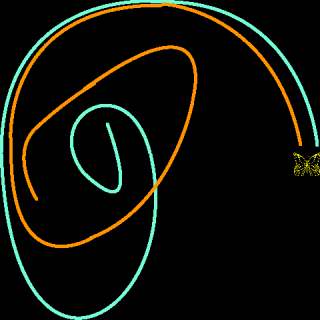
Lorentz attractor When things are chaotic, the little details make big differences. If we can use this to control and overcome the forces of nature, we can use it in other ways, too. But how much does it really help us?
Sometimes it’s the way things start that really decides how things will go.
When mathematician Edward Lorenz said a butterfly flapping its wings might ultimately cause a hurricane on the other side of the globe (alluding to Ray Bradbury’s “A Sound of Thunder”), he was describing how little changes can cause big differences in the long run. In many cases, our models of predicting the future vary a lot depending on their initial conditions. The way a population of lynx grows may vary widely by how the population began. When a river is about to flood, one person’s actions can save an entire village. These examples of the “butterfly effect”, an important tenet of chaos theory, help us figure out these things that are highly sensitive to how they begin.
We like to use “chaos” to refer to constant disorder, disarray, or other disses, but, speaking scientifically, we strictly refer to “chaotic systems” as those that satisfy three conditions. (1) you start massively influences what happens, (2) very similar starting conditions can give very different results, and (3) even if you start from very different locations, you’ll eventually end up near the same place. We’ve already touched on (1) and (2), but not so much for (3). By (3), we mean different starting points in a chaotic system will give at least similar results as they keep going repeatedly.
“What?” you’re probably thinking “Why should something chaotic give results that are similar? Shouldn’t something random give a lot of different results?” Ah, but they should! What if I told you to pick a number, and then double it repeatedly. No matter which number you pick, you’ll end up with a widely different result that is very distinct from all the other results. But some might say this isn’t “chaotic” because, no matter what you choose, you’ll end up at infinity (or negative infinity). That’s why we need this third condition.
These conditions show why our scientific theories of chaos aren’t exactly what we usually mean when we say something is “chaotic.” In the world of science, chaotic doesn’t mean completely unpredictable, random, uncertain, disorderly or just plain crazy. It’s something really interesting that shows us how to look at the world. With chaos theory, we can look at complex systems in more accurate, refined, and fun ways.
“But wait a second,” you say. “The examples you gave are just examples of things that are very very random. A leaf falling in the wind just falls unpredictably because of the wind, so how can you say its starting positions cause this?” Ah, perhaps they are! When you look at a leaf falling in the wind, how can you tell that its path will cause a hurricane in Florida or if it’s just going nowhere? There’s no way to tell them apart from another when we observe them. But, if we had the ability to create a theoretical model, we would notice chaotic systems differ from random ones in that chaotic systems would differ greatly between two starting positions that are close to one another.
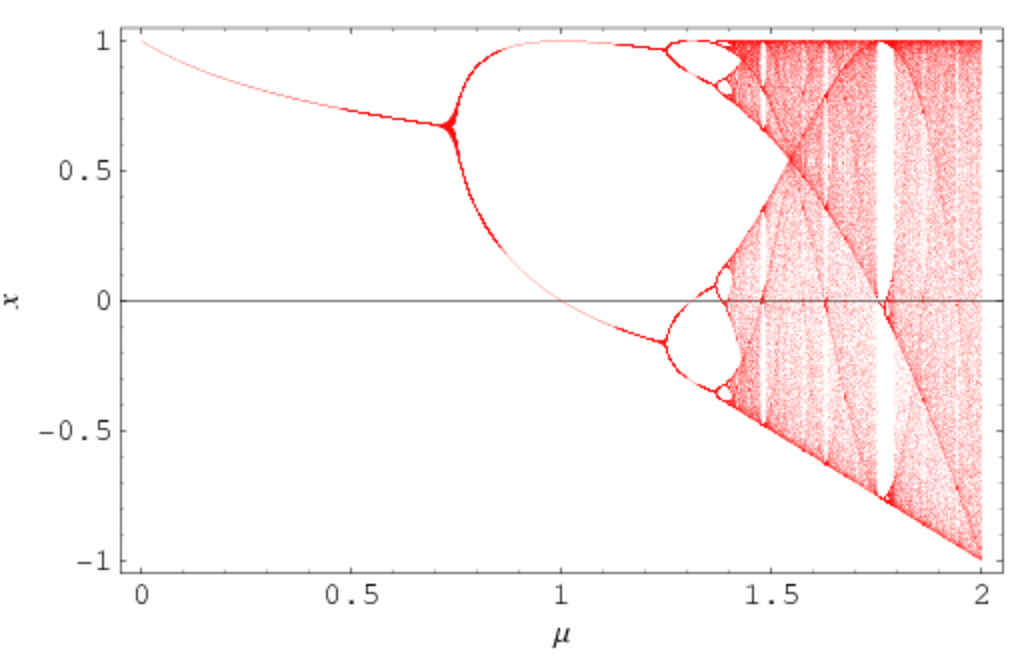
Now, you might continue and tell me, “Well, a system that changes largely based on how it begins could just be something that we don’t fully understand. What if we just haven’t made our mathematical models good enough to understand them?” Surely, if Edward Lorenz discovered the concepts of chaos theory in the 1960’s, it could have been that we were making tremendous scientific achievements and updating our understandings of things, rather than actually discovering a new phenomena itself. Feigenbaum’s constant tells us how fast a fluid can move from smooth to turbulent or, more generally, how a non-chaotic system becomes chaotic.
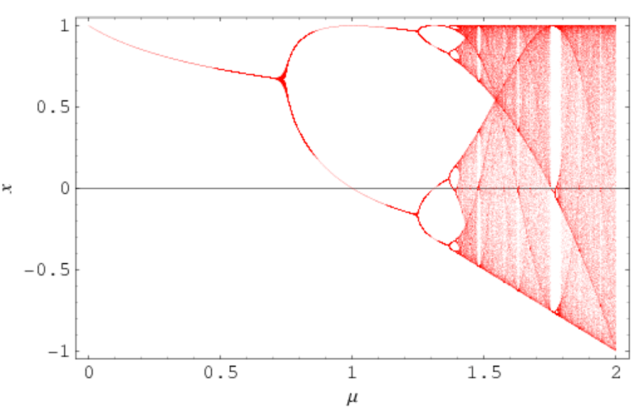
We can graph μ and x, which are two numbers that multiply to give a fixed value. By looking at different μ values that are close to one another, we can calculate δ, the Feigenbaum constant. 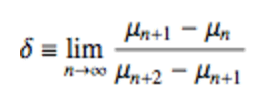
The Feigenbaum constant δ comes out to about 4.669 (or maybe we should just round up to 4.7). And, since these chaotic systems have these special conditions, chaotic systems are unique, rather than a simple “update” of our current models of looking at things. But, enough about math and science for now, what about how chaos theory works in what we do? Can we use chaos theory to explain our own actions? Let’s take a look.
People like to debate ethical questions, such as: if you had the choice to kill baby Hitler and prevent everything in his future from happening, would you? It might seem immediately obvious to do so and change the course of history, but how do you know a different future (that might be even worse) would not happen instead? In order to answer a question such as this one, we would need to understand what could happen in different situations and scenarios of history, and, before we could do that, we would need an near-perfect knowledge of cause-and-effect of 20th century German history. So how do we do it?
Scholars might use human agency as a primary cause in the course of history’s events. David F. Lindenfeld cites on Henry Turner’s “Hitler’s Thirty Days to Power” as an example of how “empowering and constraining causes of specific human actions” helps us explain history. Lindenfeld takes this idea a step further by drawing an analogy with chaos theory in that we see very different large-scale outcomes by little small-scale differences if we can look at all the different causes and courses of history we could take. Killing baby Hitler is a small event that wouldn’t ever be recorded in a history textbook, but things could be massively different on a large-scale over the decades of history. We could look at everything that happened and figure out how things would be widely different by such a small action as killing baby Hitler to make a decision. There would no WWII, no Holocaust, no Cold War, nothing as we know it. But, if chaos can make sense in history, can we really use it in our own lives?
As I mentioned at the beginning, we easily ignore details in our everyday lives. And a lot of the things in our lives are unpredictable and unforeseeable. It’s very easy to apply the butterfly effect of chaos theory to what we do in optimistic self-help advice. We can tell ourselves that the little things we do everyday will have big effects on the future (e.g., reading for 30 minutes a day, waking up earlier, working out regularly, etc.), even when those effects seem unpredictable or random. But, while it may be true those things make big differences when we do them over time, it doesn’t make sense to say they are examples of the butterfly effect. Our lives might be uncontrollable and unpredictable, but, when we make big changes in the future, they’re not simply the result of different initial conditions (as chaos theory would suggest), but, rather, from making those decisions constantly over time. In these ways, chaos theory isn’t so helpful for our individual lives.
Chaos theory has emerging as an transdisciplinary, institutional, especially thanks to science historian James Gleick’s “Chaos: Making a New Science.” With applications and techniques crossing numerous disciplines, it could be part of a greater paradigm shift in our understanding of science (and the rest of the world). It likely won’t be as huge as an entire scientific revolution, but we can be sure it’s more than just a temporary trend. And, even though we don’t know what the future will look like, I like to think these small things will make a big difference.
-
When physicists and philosophers collide
The Montagues and Capulets. The foxes and the hedgehogs. The peanut butter and jelly. Physics and philosophy have always been at odds with one another. But, when they collide, it’s like a thought experiment of particles tied to railroad tracks with the string theory leading the train.
Still, one might say physics and philosophy form a möbius strip of knowledge in which one begins where the other ends, but both fields share the same side of the coin. No matter who you ask, it’s almost impossible for a physicist not to wonder about philosophical questions such as our notions of confirmation and theory, and it’s easy to find philosophers arguing about the most basic forms of substance and material that make us who we are. If we don’t pay attention to them, then, over time, those unattended thoughts and questions grow into bigger and more serious problems. Physicists might have knowledge of fundamental particles, but lack knowledge of its metaphysical meaning. Philosophers might theorize forms of material nature without understanding of multiverses. And, through fiery debates and bad communication, the intersections of physics and philosophy become messy. That’s when we need to come together.
When physicists and philosophers convened in Munich earlier this month at a three-day workshop to talk about a new way forward for science, it’s a good sign we’re moving in the right direction. By re-evaluating ideas of truth, validity, empirical, and science itself, the grumpy old men (and women) Seeing the two disparate areas of research working together on the same problems can hopefully set a framework for a new philosophy of physics (and, altogether, a philosophy of science) that can make things better in the 21st century. The workshop, while filled with much frustration of individual understanding and value in certain areas of research (such as string theory), showed how adamant scientists were about their research. In order for them to decide the truth of their own theories, these moments of reflection are necessary to “put your work in the bigger picture.”
But the picture only goes so far. The theories physics lends us will always stay within the realm of physics, and the methods of the Munich conference don’t help too much. For example, the use of “falsifiability” as a way of defining science (i.e., scientific theories that are those that are falsifiable) has been shown to be a poor criteria for distinguishing between science and non-science by philosopher Massimo Pigliucci. It’s better for us to stick to provability using empirical results as a way of confirming science and leaving non-empirical methods to non-science.
What the workshop might have come down to was a way to decide who will get funding. And, of course, string theorists were forced to convince the world that their work was confirmable. While string theorists should definitely be able to pursue their work for the sake of that work, confirming their non-empirical theories as true using Bayesian tests (which are empirical) just won’t do us any good in the long run. We’ve been running into problems because we haven’t paid attention to the distinction between empirical and non-empirical results. And, if we try to change our notions of “empirical” to suit our standards (or use empirical methods like Bayesian tests to confirm our theories), then we’ll keep running into the same problems of putting everything together.
What this means is we should stop holding onto outdated models of “confirming” what we study in theoretical physics and stick to our standard distinctions between science and non-science. If we can’t find any ways certain theories can be confirmed, then it doesn’t mean we should stop working on them. We might be able to promote the research of certain theories for their own sake (or even for the sake of aesthetics), even if those theories are either wrong or non-confirmable.
More discourse between physicists and philosophers should put us in the right direction. We need more honesty and openness about the limits of what we know. Let’s not fool ourselves.
-
Can’t stop the gods from genetic engineering

The future is now. Genetic engineering, or modification of our biological genomes, has made tremendous strides over the past few years. This power would allow us to potentially find cures for otherwise untreatable diseases. But, as with many places of the intersection between science and humanity, we find ourselves in a tangle of ethical conundrums. Who can decide how to significantly affect someone’s genetic offspring?
A new technology, CRISPR (pronounced “krisper”) has recently seen numerous success over the past few years so much so that, when a group of scientists in China began using it to experiment on human embryos last April, the world realized we had to stop and tell ourselves “Wait a second! We’re not so sure this is the right thing to do.”
When the International Summit on Human Gene Editing convened during the first week of this month, hundreds of professionals from scientists to ethicists rigorously debated the ethical issues posed by the newfound genetic engineering technology. After the conference, they posted their conclusions of their conference online. Among their conclusions are mostly middle-ground strategies, such as allowing gene editing research on human embryos without going through the process of pregnancy or only allowing modification of Germline cells for instances of disease in which no other cure or solution is available for health and safety of the offspring (along with an understanding of safety, risks, broad consensus, and other requirements).
While the conclusions were general (as though were expected to be, as we are still in the baby steps of discussing the effects of CRISPR), hopefully we can get more detailed, nuanced approaches in the future.
The summit also concluded that we needed an international committee for detailing what we can and can’t do when it comes to gene editing, so this would definitely be a step in the right direction in light of different cultural norms with enforcing and overseeing CRISPR research.
Most of the solutions seem safe and plausible, but, in particular, why should we need a broad social consensus for proceeding with application of gene editing? Shouldn’t those decisions be made by a few experts, not a general majority opinion? We generally look at values of democracy and majority in making decisions when it comes to political or social theory. And it makes sense on the surface that, if more people agree with a solution, it will be easier and more effective (in a utilitarian sense) to carry out. But why should scientific theory (which has risky, yet pertinent health consequences) be decided the same way? The laws of science are never debated through majority opinion but, rather, academic rigor. If we’re going to take a empirical perspective (including risks, benefits, outcomes, etc.) of gene editing, then we should support decisions which are proven to be better, not by the ones which the largest number of people agree with.
All the while those who cry for greater scrutiny and more opinions pose unnecessary restrictions to incorporate a larger number of opinions that only slowing down scientific research.
Give the scientists what they need as soon as possible. Let’s hope we can understand this.









 Heuristic